

Yhteistyö esiintyjän kanssa: kun sanoitus ja ääni kohtaavat
The first time a performer sang my words back to me, I was sitting on a worn studio sofa in Helsinki with a mug of cold coffee and no idea what to expect. She opened her mouth, and suddenly the lines I had written alone at 2am belonged to someone else — carried, shaped, and lifted by a voice I could never have imagined. That moment is why I keep doing this. When sanoitus and ääni meet properly, something happens that neither the lyricist nor the performer can create alone.
Miksi yhteistyö esiintyjän kanssa on sanoittajan kultakanta
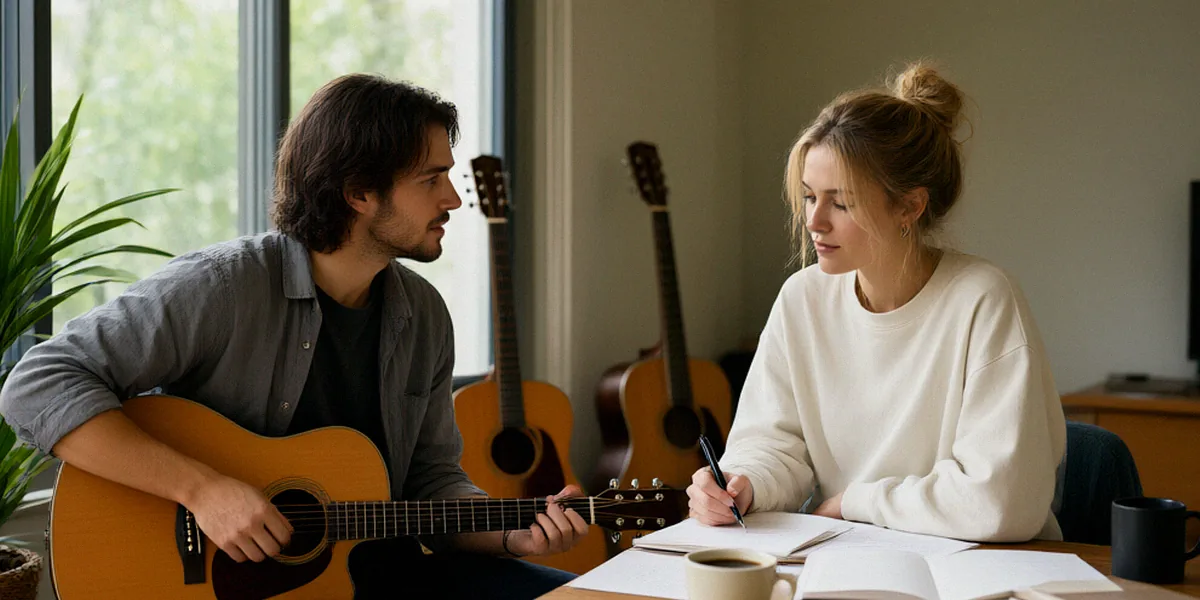
For a sanoittaja, collaboration with performers is not a nice extra — it is the goldmine. Lyrics on a page are potential; lyrics in a voice are reality. Historically, the strongest songwriting cultures have been built on this partnership. London’s Tin Pan Alley, the stretch of Denmark Street where publishers, writers and performers crowded into the same tiny rooms, produced decades of hits precisely because nobody worked in isolation. The same energy lives today in Finnish collaborations between lyricists and artists like Jarkko Ahola, whose powerful interpretation of Finnish-language material shows how much a voice can add to a text.
Sanoittajan rooli osana tiimiä
I do not see myself as a lone artist. I am part of a team, and my job is to serve the song and the performer. That means listening more than writing at first, understanding what the artist wants to say, and then finding words that fit their mouth, their breath, and their story.
Esiintyjän ääni ohjaa sanoitusta
A voice tells you things a brief never will. A raspy, lived-in tone asks for rougher consonants and shorter lines. A clear, high voice invites longer vowels and more space. When I write for a specific performer, I am essentially writing for an instrument — and that instrument changes every syllable I choose.
Sanoittaminen käytännössä: prosessi esiintyjän kanssa
Every collaboration follows roughly the same arc, even though the details shift. I have refined my process over years of working with bands, solo artists and production teams, and it usually looks like this:
- Initial meeting and brief — what is the song for, who is it for, what should it feel like?
- Reference gathering — mood boards, existing songs, keywords, phrases the artist already loves.
- Drafting — I write fast and rough, often several versions of the same chorus.
- Review with the performer — reading lines aloud, testing them against the melody.
- Revision and final polish — tightening, cutting, and making sure every word earns its place.
Aloituspalaveri ja toiveet
The kickoff meeting is where the real work begins. I ask uncomfortable questions: What are you afraid to say? What do you want people to feel in the chorus? What words do you hate? Tools like Google Docs make this stage painless — we can share notes, comment in real time, and keep a living document of the artist’s wishes.
Luonnostelusta viimeistelyyn
Drafting is messy on purpose. I would rather write five bad choruses than polish one mediocre idea. Events like The Great Escape festival in Brighton are brilliant for this stage too — the pressure of a showcase deadline forces clarity, and the songwriting camps around the festival put lyricists and performers in the same room for days at a time.
Tekstiurakoitsija sillanrakentajana
Sometimes I step in as a tekstiurakoitsija — a text contractor — for a label, a producer, or an artist who needs words delivered on schedule and to spec. In that role I am a bridge between the creative vision and the practical deadline, translating a vague brief into finished lyrics that a performer can actually sing.
Storytelling markkinoinnissa: miten sanoitus ja PR kohtaavat
The skills I use as a lyricist are the same ones that drive storytelling markkinoinnissa. A brand needs a narrative the same way a song needs a verse. Burberry’s campaigns are a textbook example: they wrap a product in a story of British craft, weather, and heritage, and suddenly a trench coat becomes a character in a larger tale. That is exactly what a good lyric does for a performer.
Tarinallistaminen osana musiikki ja PR -strategiaa
When I work on musiikki ja PR, I treat every artist as a story waiting to be told properly. Press releases, social copy, interview angles — they all come from the same source as the lyrics: a clear sense of who this person is and why anyone should care.
Esimerkkejä onnistuneista kampanjoista
Nightwish is the clearest Finnish-UK case study I know. Their international success was built not just on symphonic metal but on a sustained narrative — a band with a mythos, told consistently across albums, artwork and press. That kind of coherence is what storytelling markkinoinnissa looks like when it is done well.
Haasteet ja ratkaisut yhteistyössä esiintyjän kanssa
Not every session ends in a hit. Creative friction is normal, and pretending otherwise wastes everyone’s time.
Luova erimielisyys ja kompromissit
I have argued with performers about single words for hours. The trick is to separate ego from the song. If the artist cannot sing a line comfortably, the line is wrong — no matter how clever it looks on paper. Compromise is not defeat; it is editing with a witness.
Kieli- ja kulttuurierot
Working between Finnish and English brings real friction. Finnish is compact and vowel-heavy; English is rhythmic and consonant-dense. Idioms do not translate, and humour almost never does. Nightwish again shows how it can work: Finnish songwriting discipline paired with English-language performance, refined through years of international touring and UK-facing production.
Työkalut ja vinkit sujuvaan yhteistyöhön
Good tools remove friction so the creative conversation can breathe.
Digitaaliset alustat ja äänitys
I use Splice for loops and reference material, Soundtrap for quick shared demos, and plain voice memos more than anything else. For PR and release work I have seen excellent results from UK agencies like Prescription PR, who understand how to place an artist’s story in the right outlets.
Palaute ja iterointi
Feedback loops should be short and honest. I ask for reactions within 48 hours, and I never send more than three options at once — more than that, and the performer stops choosing and starts negotiating.
Tulevaisuuden näkymät: sanoitus ja ääni digiajassa
The next decade will reshape how lyricists and performers find each other.
Tekoäly sanoittajan apuna
AI is already useful for brainstorming rhymes, generating alternate phrasings, and stress-testing a chorus. I treat it as a sparring partner, not a replacement. The taste, the emotional accuracy, the decision about which line is true — that stays human.
Virtuaaliset yhteistyöt
Abbey Road Studios has been pushing music technology forward for decades, from early stereo experiments to modern spatial audio and remote recording workflows. Virtual collaboration means a lyricist in Tampere and a vocalist in Manchester can build a song together without ever sharing a room — and still get that spark.
Usein kysytyt kysymykset
Do you write lyrics in both Finnish and English?
Yes. I write primarily in Finnish but regularly work in English, especially for international collaborations. The approach differs — Finnish rewards compression and rhythm, English rewards clarity and idiom — but the underlying craft is the same.
How do you handle a performer who wants to change your lyrics?
I welcome it. The performer has to sing the words night after night, so their comfort matters. I ask what specifically feels wrong, then offer alternatives rather than defending the original.
What does a tekstiurakoitsija actually do?
A text contractor delivers finished, brief-compliant copy on a schedule — lyrics, marketing text, or both. It suits labels and producers who need reliable output without hiring a full-time writer.
Can storytelling marketing really help a musician’s career?
Absolutely. A clear narrative makes an artist easier to write about, easier to book, and easier to remember. Musiikki ja PR work best when they tell the same story the lyrics already tell.
How do I start a collaboration with you?
Send a short brief with the project, deadline, language, and any reference tracks. I will reply with availability and a suggested process, usually within a few days.
Successful collaboration between a lyricist and a performer comes down to three things: trust, a shared vision, and open communication. When those are in place, the meeting of sanoitus and ääni stops being a transaction and becomes something closer to magic — and that is the moment I keep writing for.